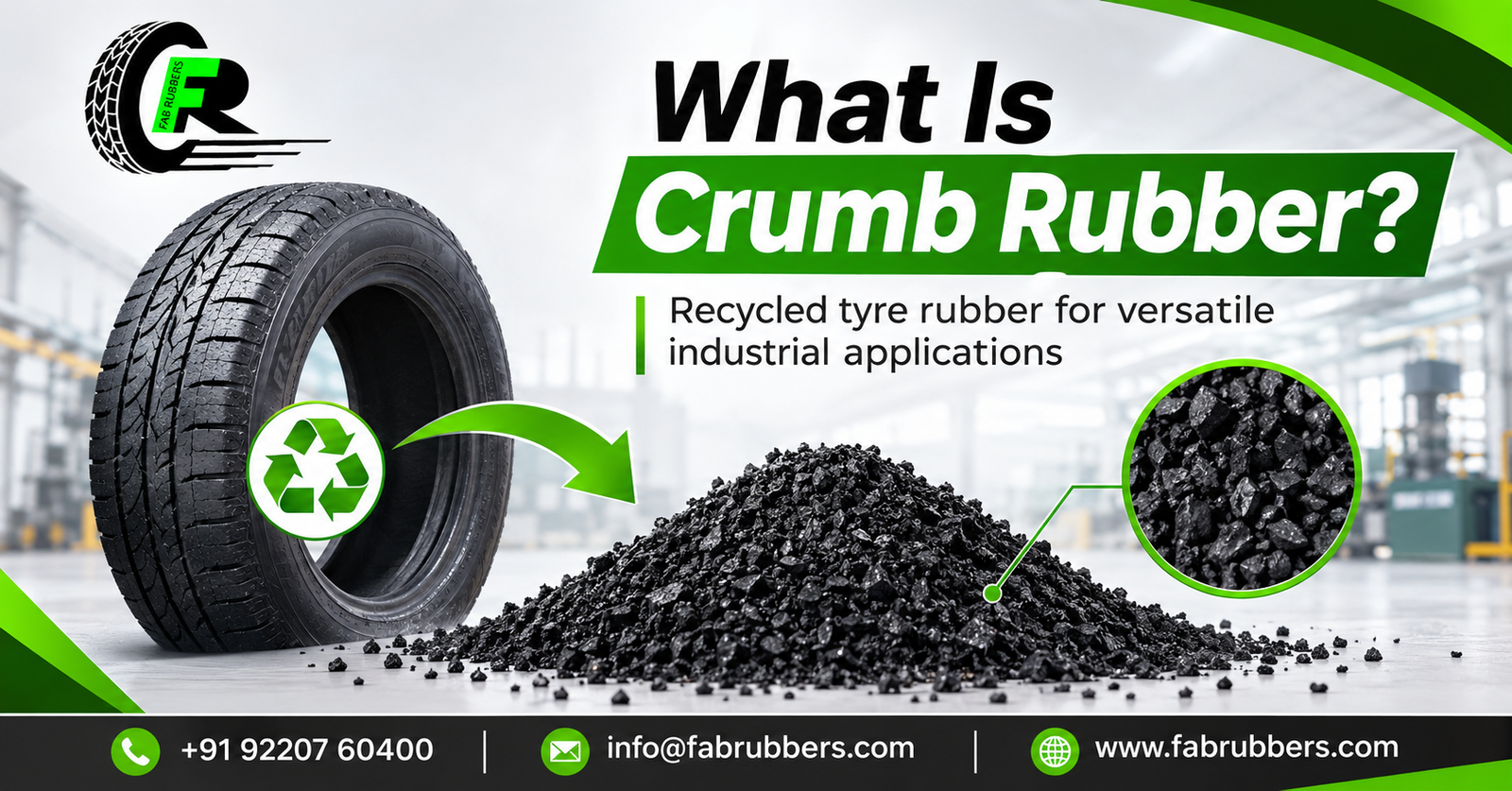
Crumb rubber is a recycled rubber material made by processing old tyres and other rubber products into small, uniform particles. It gives discarded rubber a useful second life in applications such as road construction, playground surfaces, sports flooring, gym mats, and athletic tracks. For buyers, understanding its types, manufacturing process, particle sizes, and quality standards is important before selecting a supplier. This guide explains how crumb rubber is produced, where it is used, what benefits it offers, and what you should check before placing an order.
What Is Crumb Rubber?
Crumb rubber is a granular material produced by mechanically recycling waste tyres, particularly end-of-life vehicle tyres. During processing, the tyres are broken down into smaller particles, and unwanted materials such as steel wires and textile fibres are separated.
The final product consists of rubber particles in different sizes, depending on the processing method and intended application.
It is commonly available as:
-
Recycled rubber granules: Small rubber particles used in flooring, sports surfaces, and playground installations.
-
Recycled rubber crumb: Processed tyre rubber supplied in different particle-size grades.
-
Rubber granules: Granular rubber material used in manufacturing and surface applications.
-
Rubber powder: A finer form of processed rubber used in selected industrial and manufacturing processes.
The particle size, cleanliness, consistency, and rubber composition determine whether a particular grade is suitable for a specific project.
Unlike virgin rubber, recycled rubber makes use of existing material. This helps reduce waste while providing manufacturers and contractors with a practical raw material for various applications.
Types of Crumb Rubber
Not all recycled rubber particles are the same. Their appearance, size, processing method, and intended use can vary. Understanding the available types helps buyers choose the right material for their requirements.
1. Tyre Crumb
Tyre crumb is produced by shredding and grinding discarded vehicle tyres into smaller rubber particles. Steel and textile components are removed during processing to obtain usable rubber material.
It is commonly used in road construction, flooring products, and other applications where recycled tyre rubber is suitable.
2. Tyre Rubber Granules
Tyre rubber granules are processed particles obtained from waste tyres. They are generally supplied in different sizes according to the requirements of manufacturers and installation contractors.
Their particle grading and cleanliness are important when selecting material for flooring or sports surface production.
3. SBR Rubber Granules
SBR rubber granules are made from styrene-butadiene rubber, a synthetic rubber commonly found in vehicle tyres and other rubber products.
They are widely used in manufactured rubber flooring, gym surfaces, playground systems, and sports applications where the selected formulation is suitable.
4. Rubber Crumb Powder
Rubber crumb powder refers to finely processed rubber particles. It is used in selected manufacturing applications where smaller particle sizes are required.
Its suitability depends on particle-size distribution, material composition, and the production requirements of the end product.
How Is Crumb Rubber Manufactured?
The manufacturing process involves several stages, starting with waste tyre collection and ending with graded rubber particles. Each stage affects the cleanliness, consistency, and quality of the final product.
Here is how the process generally works.
Step 1: Collection and Sorting of Waste Tyres
The process begins with collecting discarded tyres from authorised collection points, tyre dealers, vehicle workshops, and recycling channels.
The collected tyres are sorted to remove unsuitable materials and prepare them for processing. Proper sorting helps maintain consistency in the recycled material.
Step 2: Tyre Shredding
Large tyres are fed into industrial shredding machines that cut them into smaller pieces.
This makes the material easier to handle during subsequent processing. The size of the shredded pieces depends on the machinery and production requirements.
Step 3: Steel Wire Separation
Vehicle tyres contain steel reinforcement, particularly in their bead and belt sections. These metal components must be removed before the rubber can be processed further.
Magnetic separation equipment is commonly used to extract steel from shredded tyre material. Removing metal helps protect downstream machinery and improves the quality of the final rubber product.
Step 4: Rubber Grinding and Granulation
After steel separation, the rubber pieces move through grinding equipment that reduces them into smaller particles.
This stage produces tyre rubber granules in different size ranges. The selected processing method and machine settings determine the resulting particle size.
Step 5: Fibre Separation
Tyres also contain textile fibres that should be separated from the rubber.
Air classification and other separation systems help remove these fibres. Effective separation improves material cleanliness, which is particularly important for applications requiring consistent rubber particles.
Step 6: Screening and Size Grading
The processed material passes through screening equipment to separate particles according to size.
This stage produces different grades of recycled rubber granules. Oversized particles may be sent back for further grinding, while finer particles are collected separately.
The required grade depends on the intended application. For example, a flooring manufacturer may need a different particle size from a road construction contractor.
Step 7: Quality Inspection and Packaging
Before dispatch, the finished material should be checked for particle-size consistency, contamination, and visible impurities.
Once approved, the material is packed in suitable bags or bulk packaging for storage and transportation.
Important: Buyers should ask suppliers for available mesh sizes, particle-size distribution, and material specifications. Do not assume that every grade of recycled rubber is suitable for every application.
Common Mesh Sizes and Their Importance
Mesh size is an important consideration when purchasing crumb rubber. It indicates the approximate particle-size range, although actual dimensions depend on the screening standard being used.
Different applications require different particle sizes because granule dimensions influence surface texture, bonding, compaction, and material performance.
For example:
-
Coarser particles: May be suitable for selected cushioning and flooring applications.
-
Medium-sized particles: Can be used in various rubber flooring and sports surface formulations.
-
Fine particles: May be preferred for applications requiring finer material or specific manufacturing blends.
Before ordering, confirm the actual particle dimensions in millimetres or the relevant mesh specification. Two suppliers may use similar mesh labels but have different grading tolerances.
Fabrubber can add its available product grades and mesh specifications here: [Add available mesh sizes and product grades].
Major Applications of Crumb Rubber
The demand for recycled rubber has grown across several industries because manufacturers can use it as a raw material in different products. Its flexibility, cushioning characteristics, and ability to be processed into different sizes make it suitable for a range of applications.
Here are some common uses.
1. Crumb Rubber for Road Construction
Recycled tyre rubber is used in selected road construction projects as an additive in asphalt mixtures. It can help modify pavement properties when the correct material, mix design, and construction method are used.
2. Crumb Rubber for Asphalt
Crumb rubber for asphalt is processed and blended with bitumen in specific road engineering applications. The formulation and particle characteristics must match the project requirements.
3. Asphalt Rubber Modifier
An asphalt rubber modifier is used to modify bitumen for certain pavement applications. Rubber content, processing conditions, and compatibility with the binder play an important role in the final mixture.
4. Rubber Granules for Playground
Rubber granules for playground surfaces are used to create cushioned flooring systems in children's play areas. They are generally combined with suitable binders to produce a finished surface designed around the required impact-attenuation performance.
5. Rubber Granules for Gym Flooring
Rubber granules for gym flooring are used to manufacture tiles, mats, and other protective surfaces. These products can help provide cushioning and protect floors from everyday gym equipment use.
6. Rubber Granules for Sports Flooring
Rubber granules for sports flooring are used in selected indoor and outdoor sports surface systems. The particle grade and binder formulation depend on the sport, installation method, and required surface characteristics.
7. Rubber Granules for Athletic Tracks
Rubber granules for athletic tracks are used in the production of certain synthetic running track surfaces. The final surface composition is selected according to performance requirements and applicable sports standards.
Why Choose Crumb Rubber?
For manufacturers, contractors, and distributors, recycled rubber offers several practical advantages. Its suitability still depends on the quality of the raw material and the requirements of the finished product.
Here are some reasons businesses use it.
1. Supports Tyre Recycling
Discarded tyres create a significant waste-management challenge because they are difficult to dispose of through ordinary waste channels.
Recycling converts this material into a usable industrial resource and helps reduce the amount of tyre waste sent for disposal.
2. Versatile Across Industries
One of the main advantages is its wide range of potential applications.
Depending on the grade and formulation, it can be used in flooring products, playground systems, sports surfaces, road applications, and other manufactured rubber products.
3. Available in Different Particle Sizes
Manufacturers can process rubber into different particle grades to meet specific production needs.
This gives buyers more flexibility when selecting raw materials for their products. However, they should always verify the actual grading rather than relying on a general product description.
4. Useful Cushioning Properties
Rubber particles can contribute to cushioning and impact absorption when incorporated into appropriately designed flooring systems.
The actual performance depends on the particle grade, binder, installation thickness, and complete surface construction.
5. Supports Resource Efficiency
Using recycled rubber reduces the need to rely entirely on newly produced raw materials for certain applications.
For businesses working with recycled materials, it can also support more resource-efficient manufacturing and product development.
What Should Buyers Check Before Purchasing Crumb Rubber?
Choosing the right material is just as important as choosing the right supplier. Poor-quality granules can create problems during manufacturing, mixing, and installation.
Before placing an order, consider these factors:
-
Particle size: Confirm whether the available grade matches your application.
-
Material cleanliness: Check for unwanted steel wires, textile fibres, dust, and other contaminants.
-
Consistency: Ask whether the supplier maintains uniform particle sizes across batches.
-
Application suitability: Explain your intended use so the supplier can recommend an appropriate grade.
-
Packaging: Confirm the available packaging options and whether they suit your storage and transportation requirements.
-
Bulk availability: If you are purchasing for a large project, discuss quantity requirements and supply timelines in advance.
-
Product samples: Request a sample before ordering in bulk, particularly when the material will be used in a specific manufacturing process.
A reliable supplier should be able to explain the material specifications and help you identify the right grade instead of recommending the same product for every application.
Conclusion
Crumb rubber has become a useful recycled raw material for industries that manufacture flooring, playground surfaces, sports products, and road construction materials. Its applications depend on particle size, material quality, and the requirements of the final product.
Understanding the manufacturing process and available grades helps buyers avoid unsuitable materials and make better purchasing decisions.
At Fabrubber, we focus on supplying recycled rubber granules and crumb rubber for different industrial and commercial requirements. If you are looking for a suitable grade for your next project, contact our team to discuss your application, request product specifications, or enquire about available samples and bulk orders.