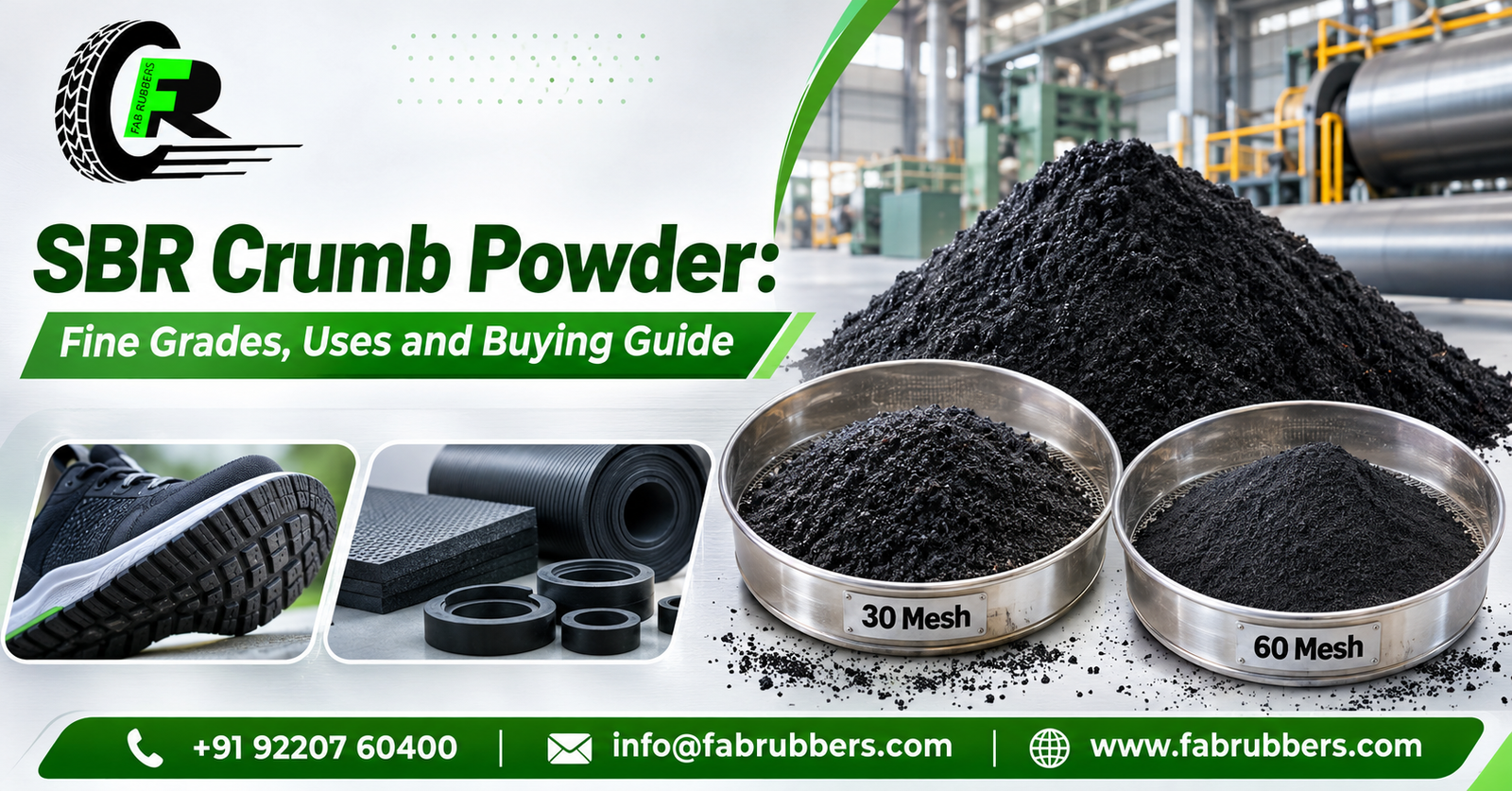
SBR Crumb Powder is a recycled rubber material widely used in manufacturing, rubber compounding, flooring products and other industrial applications. Produced by processing scrap tyres and other suitable rubber waste, it is available in different particle sizes to meet specific production requirements. Buyers often compare fine rubber powder and larger SBR crumb granules without knowing which grade will work best for their application. Choosing the wrong particle size can affect mixing, product consistency and processing costs. This guide explains how SBR Crumb Powder is manufactured, the available grades, its common applications and what you should check before purchasing from a supplier.
What Is SBR Crumb Powder?
SBR Crumb Powder is a finely processed recycled rubber material made primarily from Styrene-Butadiene Rubber (SBR). It is commonly recovered from end-of-life tyres through mechanical recycling, where rubber is separated, ground and screened into different particle sizes.
Unlike larger rubber granules, SBR Crumb Powder has a finer particle structure. This makes it suitable for applications where manufacturers need smaller rubber particles for blending, compounding or material production.
The material is generally black because of the carbon black used in tyre manufacturing. Its physical characteristics can vary depending on the original rubber source, recycling process and screening method.
SBR crumb rubber powder is used by manufacturers who want to incorporate recycled rubber into their products while managing raw material costs.
How Is SBR Crumb Powder Different from Regular Rubber Granules?
The main difference is particle size and the way the material is used.
-
SBR Crumb Powder: A finer rubber material used in applications that require smaller particles and better distribution within a mixture.
-
SBR Rubber Granules: Larger rubber particles commonly used in flooring systems, playground surfaces and other applications where granular material is required.
-
Fine Rubber Powder: A more finely processed form used in certain rubber manufacturing and compounding processes.
The right option depends on your production method. For example, a manufacturer blending recycled rubber into a rubber compound may prefer a finer grade, while a flooring installer may need larger granules.
How Is SBR Crumb Powder Manufactured?
The quality of SBR Crumb Powder depends on the raw material, processing equipment and separation methods used during recycling.
Most mechanically recycled SBR powder follows a process involving several stages.
1. Collection and Selection of Raw Materials
The process starts with collecting used tyres and other suitable rubber waste. The incoming material is inspected and sorted before processing.
Removing unsuitable materials at this stage helps maintain consistency in the finished product.
2. Removal of Steel and Textile Components
Scrap tyres contain steel wires and textile fibres that must be separated from the rubber.
Specialised machinery helps remove these unwanted components. Proper separation is important because excessive metal or fibre contamination can create problems during manufacturing.
3. Primary Rubber Shredding
The prepared tyre material passes through shredding machines that break it into smaller rubber pieces.
This stage reduces the material to a manageable size for further grinding. The output is still relatively coarse compared with the final powder.
4. Grinding and Size Reduction
The shredded rubber moves through grinding equipment, where mechanical action reduces the particles further.
The grinding process determines the particle characteristics of the recycled rubber. Equipment settings and processing conditions influence the final size distribution.
5. Screening and Particle Classification
After grinding, the material passes through screening systems that separate different particle sizes.
This is an important stage in producing SBR Crumb Powder. Fine particles are separated from larger rubber pieces, allowing manufacturers to supply different grades according to buyer requirements.
6. Final Quality Inspection and Packaging
Before dispatch, the finished material should be checked for particle-size consistency, visible contamination and moisture.
The approved material is then packed in suitable bags or bulk packaging, depending on the order quantity and transportation requirements.
SBR Crumb Powder: Understanding Fine Grades
Particle size is one of the first specifications buyers should consider when purchasing SBR Crumb Powder.
A fine grade may work well in one manufacturing process but create difficulties in another. For this reason, buyers should select the grade according to the intended application instead of choosing the finest available option.
What Determines the Grade of SBR Crumb Powder?
Several factors influence the classification of rubber powder:
-
Particle size: Determines how fine or coarse the material is.
-
Screening accuracy: Helps maintain the required size distribution.
-
Raw material quality: Influences the physical characteristics of the recycled rubber.
-
Grinding process: Affects particle shape and consistency.
-
Contamination level: Indicates the presence of unwanted metal, textile or other materials.
Common Particle-Size Categories
SBR crumb rubber powder can be supplied in different mesh sizes depending on the manufacturer's machinery and screening capabilities.
Mesh size refers to the number of openings per linear inch in a screening system. Generally, a higher mesh number indicates a finer material.
Grade category |
General characteristics |
Typical buyer consideration |
|
Coarse crumb |
Relatively larger rubber particles |
Suitable for processes requiring larger particles |
|
Medium crumb |
Intermediate particle size |
Used where a balance between particle size and processing is required |
|
Fine crumb powder |
Smaller rubber particles |
Suitable for fine blending and compounding |
|
Very fine rubber powder |
More finely processed material |
Used in applications requiring finer particle distribution |
Actual particle-size ranges vary between suppliers. Always request the manufacturer's available mesh sizes and particle-size specifications before placing an order.
SBR Crumb Rubber Granules: Uses and Characteristics
SBR crumb rubber granules are produced by processing recycled rubber into particles of different sizes. They are generally larger than fine rubber powder and are used in applications where a granular structure is preferred.
These granules are commonly used in:
-
Rubber flooring manufacturing
-
Playground surface production
-
Sports flooring systems
-
Rubber moulded products
-
Certain industrial rubber applications
The selection between granules and powder depends on the final product's design and manufacturing requirements.
For example, a manufacturer producing rubber sheets may require a different particle size from a company manufacturing moulded rubber components.
SBR Crumb Rubber Powder: Major Industrial Applications
The usefulness of SBR Crumb Powder comes from its ability to be incorporated into different manufacturing processes. However, its suitability depends on the required particle size, material composition and processing conditions.
Here are some common applications.
1. Rubber Compounding and Manufacturing
Rubber manufacturers use recycled rubber powder in selected formulations to produce different rubber-based products.
It can be blended with other materials depending on the required product characteristics. Manufacturers should test compatibility and processing performance before using it in commercial production.
2. Rubber Sheets and Mats
Fine SBR powder can be considered for certain rubber sheet and mat manufacturing processes.
The appropriate grade depends on the production method, binder or rubber formulation and required surface finish.
3. Moulded Rubber Products
Some manufacturers incorporate recycled rubber powder into moulded products where the formulation allows it.
The particle size and cleanliness of the material matter because inconsistent feedstock can affect the finished product.
4. Industrial Rubber Products
SBR crumb powder can be used in selected industrial rubber applications as part of a wider material formulation.
Buyers should confirm the required physical properties and processing compatibility before selecting a grade.
5. Construction-Related Applications
Certain construction materials incorporate recycled rubber as a component of their formulations.
However, not every construction application can use the same grade. Manufacturers should evaluate the material according to the intended product specifications.
6. Recycled Rubber-Based Products
SBR powder also supports the production of various recycled rubber products.
Depending on the formulation, it may be used in products where manufacturers want to incorporate recovered rubber material into new applications.
Black SBR Granules: Why Are They Commonly Used?
Black SBR granules are widely available because recycled tyre rubber is a major source of SBR-based material.
The black appearance is mainly associated with carbon black used in tyre compounds. This material is commonly retained during mechanical recycling.
Buyers often choose black SBR granules because they are suitable for several applications where colour is not a major design requirement.
Some common uses include:
-
Rubber flooring and mat production
-
Playground surface systems
-
Sports and recreational flooring
-
Industrial rubber products
-
Rubber moulding applications
When purchasing black SBR material, appearance alone should not determine quality. Check particle-size consistency, cleanliness and other specifications relevant to your manufacturing process.
Benefits of Using SBR Crumb Powder
SBR Crumb Powder offers several practical advantages for manufacturers and industrial buyers.
Supports Rubber Recycling
The material comes from recovered rubber waste, helping divert used tyres and other suitable rubber materials from disposal.
Using recycled rubber also creates opportunities to incorporate recovered materials into new manufacturing processes.
Available in Different Particle Sizes
Manufacturers can select different grades according to their production requirements.
This flexibility makes it easier to identify a suitable material for fine mixing, rubber compounding or other applications.
Useful Across Multiple Industries
SBR crumb powder is used in different rubber-based manufacturing processes. Its applications depend on the formulation, processing method and final product requirements.
Helps Optimise Raw Material Selection
Recycled rubber can be considered as part of a cost-conscious material formulation.
However, the actual cost advantage depends on the grade, processing requirements, transportation and the amount of material used in the finished product.
Supports Sustainable Manufacturing
Using recycled SBR material helps make productive use of recovered rubber resources. It can be part of a broader approach to reducing dependence on virgin raw materials.
How to Choose the Right SBR Crumb Powder: A Buying Guide
Choosing a supplier involves more than comparing prices. The material must match your production requirements, and its specifications should remain consistent across orders.
Before purchasing SBR Crumb Powder, consider these factors.
1. Confirm the Required Mesh Size
Start by identifying the particle size your production process requires.
Ask the supplier for the available mesh grades and particle-size distribution. If your application has a specific tolerance, communicate it before ordering.
2. Check Material Cleanliness
Contamination can affect processing and the quality of the finished product.
Ask about the separation process and confirm the acceptable limits for metal, textile fibres and other unwanted materials.
3. Understand the Raw Material Source
Find out whether the powder comes from recycled tyres or another suitable rubber source.
The raw material can influence the composition and physical characteristics of the finished powder.
4. Request a Material Sample
A sample allows you to check the material before committing to a larger purchase.
You can evaluate its appearance, particle consistency and suitability for your production process. Where necessary, conduct a small-scale manufacturing trial.
5. Compare Specifications Instead of Price Alone
Two suppliers may quote different prices for products described using the same grade name.
Compare the actual particle size, material composition, contamination levels, packaging and quantity before making a decision.
A lower-priced material may not be economical if it requires additional processing or creates production problems.
6. Check Packaging and Supply Capacity
Packaging should protect the powder from moisture and contamination during storage and transportation.
For regular industrial requirements, discuss order quantities, lead times, packaging options and the supplier's ability to maintain consistent specifications.
Why Choose a Reliable SBR Crumb Powder Manufacturer?
A reliable manufacturer helps buyers get material that matches their actual production requirements.
When evaluating a rubber recycling company, look beyond the product description. Ask for technical details, available grades and information about quality inspection.
A dependable SBR crumb powder supplier should be able to explain:
-
Available mesh sizes and particle-size ranges.
-
Raw material sources and processing methods.
-
Material cleanliness and quality checks.
-
Packaging and bulk supply options.
-
Sample availability and order requirements.
For manufacturers purchasing regularly, consistency between batches is particularly important. A supplier who understands your application can help you select a suitable grade and reduce the chances of material mismatch.
At Fabrubber, buyers can enquire about recycled rubber materials and discuss their specific product requirements before finalising an order.
Conclusion
Selecting the right SBR Crumb Powder starts with understanding your application and the particle size it requires. Factors such as mesh grade, material cleanliness, raw material source and batch consistency can all affect the suitability of the product.
Whether you need fine rubber powder for manufacturing or larger SBR crumb granules for another application, compare the actual specifications before purchasing.
Looking for a suitable recycled rubber material for your production requirements? Contact Fabrubber to discuss your required grade, available particle sizes and bulk supply needs. Request product details or a sample to evaluate the material before placing your order.