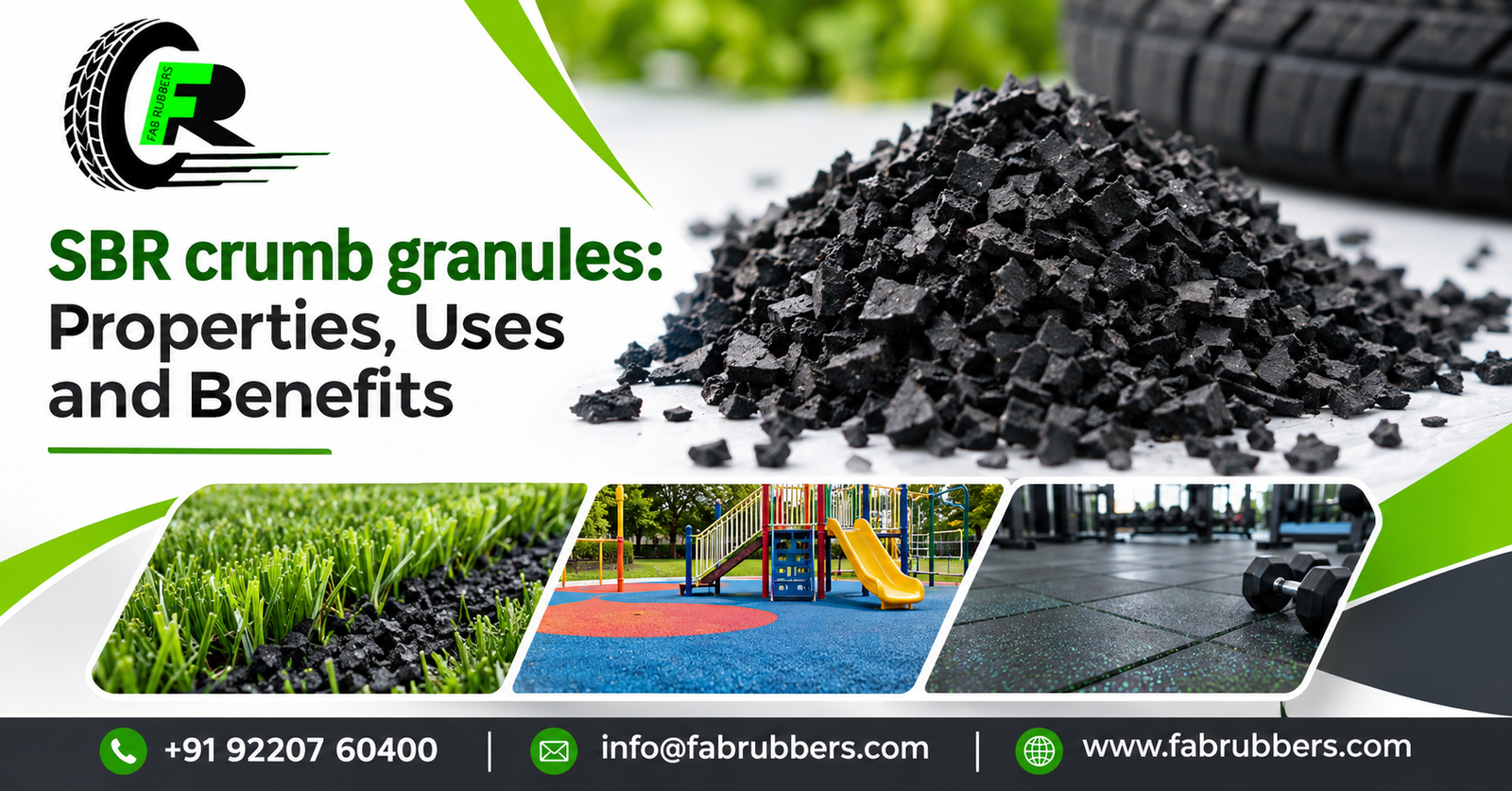
SBR crumb granules are widely used in flooring, playground surfaces, gym installations, and sports facilities because of their flexibility, cushioning properties, and durability. Made from styrene-butadiene rubber, these granules are commonly obtained by processing recycled vehicle tyres. Their particle size, material quality, and consistency determine how well they perform in different applications. Whether you are a flooring contractor, manufacturer, or distributor, understanding SBR crumb granules can help you select the right material for your project. This guide covers their manufacturing process, properties, available sizes, applications, and key benefits.
What are SBR crumb granules?
SBR stands for Styrene-Butadiene Rubber, a synthetic rubber widely used in automotive tyres and various industrial products. SBR crumb granules are small particles of this material, generally produced by processing and recycling used tyres.
These granules are usually black and are available in different particle sizes depending on the processing method and intended application.
Unlike large pieces of recycled rubber, granules are easier to mix with binders and incorporate into manufactured products. This makes them useful for producing rubber tiles, cushioned flooring systems, and other rubber-based surfaces.
SBR crumb granules are commonly selected for applications where buyers need:
-
Flexible and resilient rubber material.
-
Cushioning and shock-absorbing properties.
-
Consistent particle sizes for manufacturing.
-
Recycled raw material for rubber-based products.
-
Material that can be combined with suitable polyurethane binders.
The final performance depends on the rubber composition, particle grading, processing quality, and installation method.
How Are SBR Crumb Granules Made?
SBR crumb granules are commonly manufactured through a mechanical recycling process that converts discarded tyres into smaller rubber particles.
The process involves several stages. Each one helps improve the cleanliness, consistency, and usability of the finished material.
1. Collection of Used Tyres
The process starts with collecting discarded vehicle tyres from suitable recycling and collection channels.
These tyres contain rubber compounds, steel reinforcement, and textile materials. Before processing, the collected material is sorted and checked for suitability.
2. Tyre Shredding
The selected tyres are fed into industrial shredding machines that break them into smaller pieces.
Shredding reduces the size of the material and makes it easier to handle during subsequent processing.
3. Steel Wire Removal
Tyres contain steel wires that must be separated from the rubber.
Magnetic separation systems are commonly used to remove these metal components. Effective steel removal helps protect processing equipment and improves the cleanliness of the material.
4. Rubber Grinding
After metal separation, the shredded rubber moves through grinding machines that reduce it into smaller particles.
This stage produces recycled rubber granules in different size ranges. The machine settings and grinding method influence the final particle dimensions.
5. Fibre Separation
Textile fibres present in tyres are removed using suitable separation equipment, such as air classification systems.
This step is important because excessive fibre contamination can affect the appearance and suitability of the finished material.
6. Screening and Grading
The processed rubber passes through screening equipment to separate particles according to their size.
Oversized particles may return for additional grinding, while the required grades are collected separately.
7. Quality Checking and Packaging
Before packaging, the finished granules should be inspected for particle-size consistency and unwanted contamination.
Once checked, the material is packed in suitable bags or bulk packaging for storage and transportation.
For buyers, it is worth asking suppliers about their processing methods, available grades, and quality inspection practices before placing an order.
Properties and Sizes of SBR crumb granules
The properties of SBR crumb granules make them suitable for several flooring and manufacturing applications. However, buyers should understand that performance can vary depending on the original rubber composition and processing conditions.
Here are the main characteristics to consider.
1. Flexibility and Resilience
SBR is known for its flexible rubber structure. Its granules can contribute to the resilience of finished rubber products.
This property is useful in applications where the surface needs to withstand regular movement, pressure, and repeated use.
2. Cushioning and Shock Absorption
When incorporated into a properly designed flooring system, SBR crumb granules can help create a cushioned surface.
The level of impact absorption depends on factors such as granule size, binder ratio, installation thickness, and the overall flooring design.
3. Durability
SBR is used in products that experience regular mechanical use. When processed and installed correctly, it can contribute to durable flooring and rubber-based products.
Actual service life depends on environmental exposure, maintenance, product formulation, and usage conditions.
4. Water Resistance
SBR has useful water-resistant characteristics. However, the water resistance of a finished flooring system also depends on its binder, surface structure, drainage, and installation quality.
5. Particle Size and Consistency
Particle size is one of the most important factors when selecting SBR material.
Different applications require different granule dimensions. Consistent grading helps manufacturers achieve more predictable mixing and surface finishing.
Common SBR Granule Sizes
Illustrative size categories. Confirm actual product availability and specifications with the manufacturer.
|
Granule size |
Typical considerations |
|
1–2 mm |
Smaller particles for selected fine-texture applications |
|
2–3 mm |
Medium-sized particles for certain flooring formulations |
|
3–4 mm |
Coarser particles for selected rubber product applications |
|
1–4 mm |
A broader grading range used where the product specification permits |
For example, rubber granules 1-4 mm may be considered for certain flooring formulations, but the correct grade should be selected according to the required surface texture and manufacturing process.
Black SBR crumb granules
Black SBR crumb granules are commonly produced from recycled tyres. Their colour comes from the original rubber compounds used in tyre manufacturing.
They are used in different rubber flooring and manufacturing applications. Buyers should check particle cleanliness, grading, and consistency rather than judging quality by colour alone.
Fabrubber can add its verified product specifications here: 30 Mesh Rubber granules and 60 Mesh Rubber granules.
Uses of SBR crumb granules
SBR crumb granules are used across several industries because they can be incorporated into different rubber products and surface systems.
The final application depends on the particle size, binder compatibility, installation requirements, and expected surface performance.
1. Rubber Granules for Flooring
Rubber granules for flooring are used to manufacture rubber tiles, protective mats, and other flooring products.
They are mixed with suitable binders and processed into surfaces designed for commercial, recreational, and industrial spaces.
2. Rubber Granules for Playground
SBR material is used in certain playground flooring systems to create cushioned surfaces beneath play equipment.
The finished surface should be designed and tested to meet the applicable impact-attenuation and playground safety requirements.
3. Rubber Granules for Gym Flooring
Gym flooring products often use SBR crumb granules to provide cushioning and help protect the underlying floor from equipment and repeated foot traffic.
They can be incorporated into rubber gym tiles and protective mats, depending on the required thickness and density.
4. Rubber Granules for Sports Flooring
SBR crumb granules are used in selected sports flooring systems where surface resilience and cushioning are important.
The required formulation varies according to the sport, installation method, and intended playing conditions.
5. Rubber Granules for Athletic Tracks
Certain synthetic athletic track systems use SBR crumb granules as part of their rubber surface composition.
The selected material and installation process must meet the relevant performance requirements of the track system.
Benefits of SBR crumb granules
SBR crumb granules offer several practical advantages for manufacturers, contractors, and businesses working with rubber-based products.
1. Supports Rubber Recycling
One of the main advantages is that SBR crumb granules can be produced by recycling discarded tyres.
This process converts used rubber into a material that can be reused in different manufacturing applications.
2. Suitable for Multiple Applications
SBR material can be incorporated into different rubber products, including flooring tiles, gym mats, playground surfaces, and sports flooring systems.
This versatility makes it useful for businesses serving different industries.
3. Available in Different Sizes
Manufacturers can process SBR material into various particle-size grades.
This allows buyers to select granules according to their production requirements rather than relying on a single standard size.
4. Useful Cushioning Properties
When used in suitable flooring formulations, SBR crumb granules can contribute to cushioning and impact absorption.
This is particularly relevant for surfaces used in gyms, recreational areas, and sports facilities.
5. Practical for Rubber Product Manufacturing
SBR crumb granules can be mixed with compatible binders and processed into finished rubber products.
Their suitability depends on the required formulation, particle consistency, and production method.
6. Helps Reduce Tyre Waste
Recycling used tyres into granules helps recover material that might otherwise require disposal.
It supports the reuse of existing rubber resources in suitable industrial applications.
Why Choose a Rubber Granules Manufacturer in India?
Selecting a reliable manufacturer is an important part of maintaining product quality and consistent production.
Whether you are purchasing material for flooring installation or manufacturing rubber products, your supplier should understand the technical requirements of the application.
Here are some factors worth checking before making a decision.
1. Product specifications: Ask for clear details about particle sizes, grading, and material composition.
2. Consistent quality: Check whether the manufacturer follows regular inspection procedures to maintain consistency between batches.
3. Processing capability: Understand the manufacturing and separation methods used to remove unwanted steel and textile contamination.
4. Bulk supply requirements: Discuss the quantity you need, packaging options, and expected supply timelines.
5. Technical assistance: A knowledgeable supplier should help you understand which grade may be suitable for your intended application.
6. Sample availability: Request a sample so you can inspect the material before confirming a larger order.
Working with an experienced rubber granules manufacturer in India can make material selection and supply planning easier.
For businesses handling regular projects, a dependable rubber granules supplier should also communicate clearly about product availability and specifications.
Conclusion
SBR crumb granules are a useful recycled rubber material for manufacturers and contractors working across flooring, playground, gym, and sports surface industries. Their flexibility, cushioning characteristics, and availability in different particle sizes make them suitable for a variety of rubber-based products.
However, choosing the right grade is essential. Particle consistency, material cleanliness, and compatibility with the intended application can directly affect the quality of the finished product.
At Fabrubber, we supply recycled rubber granules and crumb rubber for different industrial and commercial requirements. If you are looking for suitable SBR material for your next project, get in touch with our team to discuss available grades, request product specifications, or enquire about samples and bulk supply.
Explore our product range: https://www.fabrubbers.com/